In 2018, the problem was being seen. In 2026, the problem is being believed.
For ten years, professionals were taught to get noticed in seven seconds. Today every application looks good — and what has become rare again is proof.
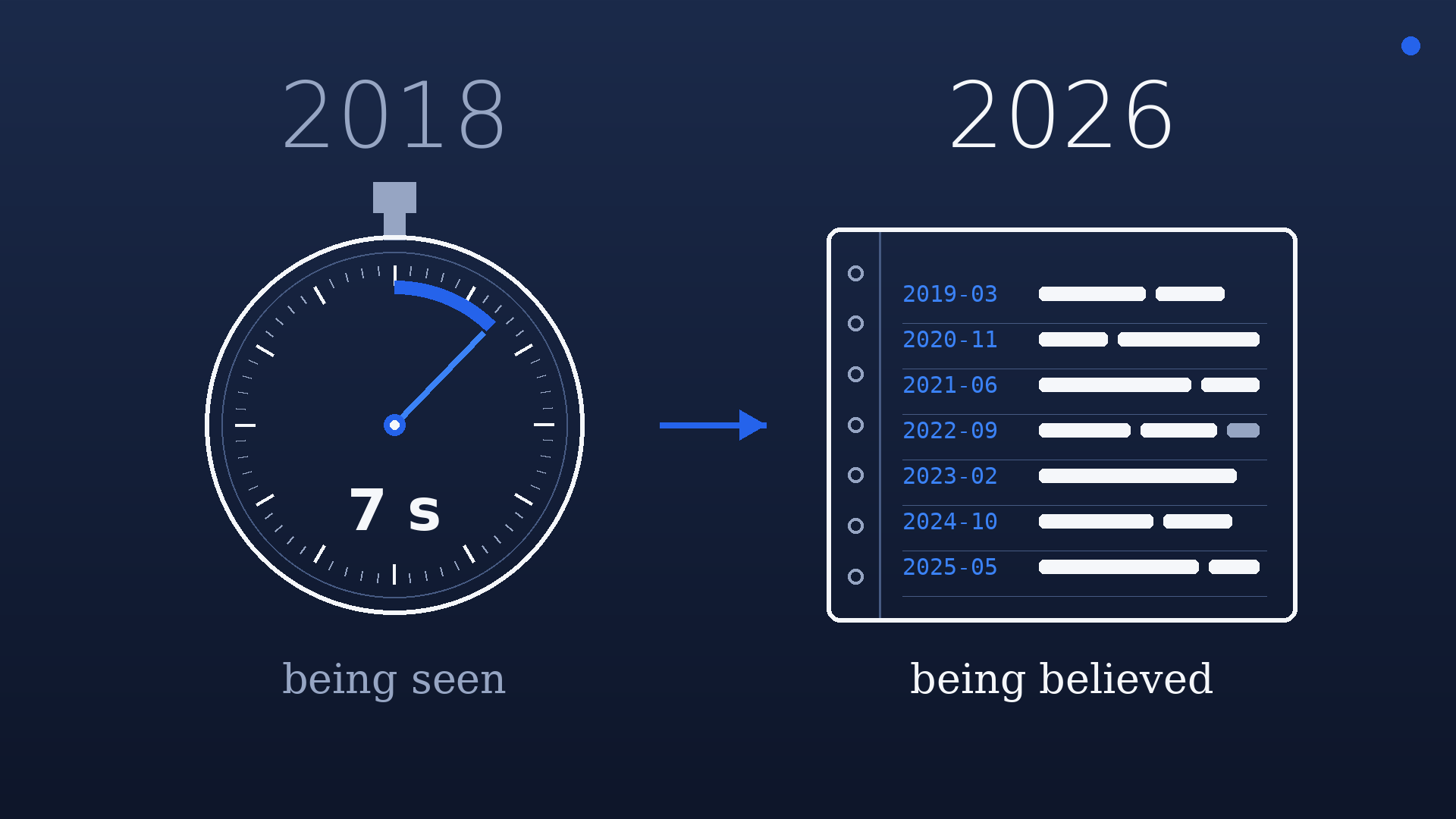
In 2018, an eye-tracking study by Ladders measured something everyone suspected but no one had dared to quantify: a recruiter spends about 7.4 seconds on a résumé during the first screen. Seven seconds. Long enough to read a title, spot two dates, and decide.
An entire industry organized itself around that number. You had to be seen. The eye had to stop. We learned to rank information, to bold the results, to remove the columns that confuse automated parsing. Career advice became an art of visibility.
The logic had its coherence. When hundreds of applications arrive for one position, getting noticed is a real problem.
But something happened in the meantime. The problem moved, and most of the advice still given today answers yesterday's question.
The ghost that shaped a decade
First, a belief that has absorbed a great deal of energy needs to be settled: the idea that 75% of résumés are automatically rejected by applicant tracking systems before a human ever sees them.
That figure did not come from a study. It came from a sales pitch published in 2012 by a company called Preptel, which sold precisely the résumé-optimization services the figure justified. No methodology was ever published. No sample. The company closed its doors in August 2013. The number, however, survived — repeated from article to article, each citing the previous one, until it became an established fact that no one thinks to verify anymore.
Recent data tells a different story. A survey of American recruiters conducted in late 2025 reports that 92% of them say their systems do not automatically reject applications for formatting or keyword reasons. Automatic rejections exist, but they hinge on explicit knockout questions — work authorization, for instance — not on some mysterious algorithmic score.
What actually screens out applications is volume. Hundreds of files, limited human time, and a fast read that sets aside whatever doesn't speak quickly enough.
For ten years, then, competent professionals were taught to defend themselves against an adversary that did not exist, while the real obstacle remained what it had always been: a tired human being reading too many documents that look alike.
The reversal of 2026
Here is what changed, and the numbers are Canadian.
In March 2026, Robert Half surveyed more than 1,500 recruiters across Canada. The result: 61% of HR leaders say that reviewing AI-generated applications has slowed down their hiring process. And 64% report that the rising volume and authenticity problems of AI-produced résumés create significant challenges for their organization.
A follow-up survey, published in June, shows the mirror image on the candidate side: among those looking for work, 51% believe AI-generated applications have intensified the competition.
Let's translate. Eight years ago, the problem was that a good application went unnoticed. Today, the problem is that every application looks good.
A recruiter opens thirty résumés. They are all well structured. They all use the exact vocabulary of the posting. They all display quantified results. None stands out — and that is precisely the problem. Conformity no longer discriminates anything.
Why the résumé stopped being a signal
There is a deeper reason for this, and it has nothing to do with technology.
A signal only distinguishes if it is expensive to imitate. This is true everywhere: a degree signals something because it takes years; a recommendation signals something because the person giving it stakes their reputation.
Writing a résumé well calibrated to a specific posting used to require several hours, a good understanding of the role, and some command of writing. That cost was the signal. The candidate who had paid it demonstrated, by that gesture alone, real interest and an ability to structure their thinking.
That cost has dropped to zero. Pasting a job posting into an AI tool and getting a perfectly aligned résumé now takes a few seconds.
What everyone can produce without effort no longer credits anyone. The résumé hasn't disappeared — it has simply stopped proving anything. It remains necessary to enter the process; it is no longer sufficient to come out of it.
The burden has shifted, and it falls on the honest
In the same survey, 79% of hiring managers say they are able to spot the use of AI in an application.
That statistic deserves a careful reading. It does not measure a detection capability — it measures a conviction. And if all résumés look alike, the conviction of detecting quickly turns into generalized suspicion.
This is the most unfair consequence of the current period. The professional who actually led that team, actually delivered that project, actually obtained that result, now writes the same sentences as the one who asked a machine to invent them. And is evaluated with the same distrust.
The screening does not disappear. It moves to the interview — that is, to the most expensive stage of the process. Organizations call in more candidates to retain as many. They pay in managers' hours for what they can no longer obtain by reading.
Everyone loses. The recruiter, who screens for longer. The genuine candidate, whose word is now worth anyone's. And the organization, which makes costly hiring decisions with less information than before.
What is becoming rare again
If conformity no longer distinguishes, what still does?
Priority in time. An achievement documented three years before a job posting existed could not have been calibrated for it. Someone who noted what they accomplished at the moment they accomplished it — without knowing whom they would one day tell — holds something no one can manufacture retroactively. It's not a question of tools. It's a question of timing.
Grip. A situated, dated achievement, with its context and its obstacles, gives the recruiter something to ask about. Who was on the team? How did you measure that result? What nearly failed? Someone who lived it answers with details no one invents. Someone who embellished collapses at the third question. Verifiability is not an extra layer of rigour: it is what makes you believable.
The third party. Confirmation from someone who was there. It is hard to obtain, and that is exactly why it is worth something. In a world where producing a beautiful document costs nothing, the only thing that keeps its value is what still requires another person to agree to put their name on it.
What this changes for you
None of the above suggests giving up AI tools. That would be bad advice, and advice no one will follow.
But you need to see clearly what they do and don't do. They improve wording. They don't improve proof. And in a market where everyone words things well, proof becomes the scarce resource.
The shift to make is simple to state and demanding to carry out: stop preparing a résumé, start keeping a record.
Note your achievements when they happen, not when you need them. Keep the numbers, the dates, the names, what went wrong before it went right. You are not writing for a recruiter — they don't exist yet. You are writing for yourself, six months or four years from now.
It is precisely because you had nothing to sell when you wrote it that it will be credible when you show it.
In 2018, it took seven seconds to be seen. In 2026, it takes years to be believed. It's longer, it's less spectacular, and it's the only thing that doesn't automate.
Where to start
You don't need any tool to keep this record. A notebook is enough, as long as you write down each time the context, your exact role, what pushed back, the result and how it was established.
If you would rather have that record structured, dated, and readable when you need it, that is exactly what SoiWISE does: each achievement is recorded with its five questions, with a cool head, before the job exists — and the job attaches to it later, not the other way around.
Your first key moment is free, no credit card, until October 31, 2026. Zero cookies, zero trackers: your reflections belong to you.
Choose. Don't be chosen.
Read also:
- Changing careers — but to what? — fifteen years of achievements already hold the answer
- 3 Behavioral Strengths That Set You Apart: The Key Question — the question that disarms 90% of professionals in interviews
Sources
- Ladders, Inc., Ladders Updates Popular Recruiter Eye-Tracking Study, press release, November 6, 2018 — average initial résumé screen: 7.4 seconds. prnewswire.com
- Robert Half Canada, survey of more than 1,500 Canadian hiring managers, press release, March 11, 2026 — 61%, 64%, 79%. presse.roberthalf.ca
- Robert Half Canada, survey of Canadian professionals, press release, June 15, 2026 — 51% of job seekers. newswire.ca
- Enhancv, The ATS Rejection Myth: 25 Recruiters Explain What Really Happens, interviews with 25 U.S. recruiters, September–October 2025 — 92% of systems do not auto-reject. enhancv.com
- Christine Assaf, Your Job Application Was Rejected by a Human, Not a Computer, HRTact, October 5, 2020 — tracing the 75% statistic to Preptel (2012), dissolved in August 2013. hrtact.com
Denis Bellerose is the founder of SoiWISE.com and the co-author of Ingénierie de la performance des organisations (2021). With 35 years of experience on both sides of the table — as employee, manager, consultant, and entrepreneur — he now helps professionals navigate their key career moments, alongside two seasoned HR and recruitment specialists.