3 Behavioral Strengths That Set You Apart: The Key Question
90% of professionals have never received objective feedback on their strengths. The interview question that changes everything — and how to actually answer it.
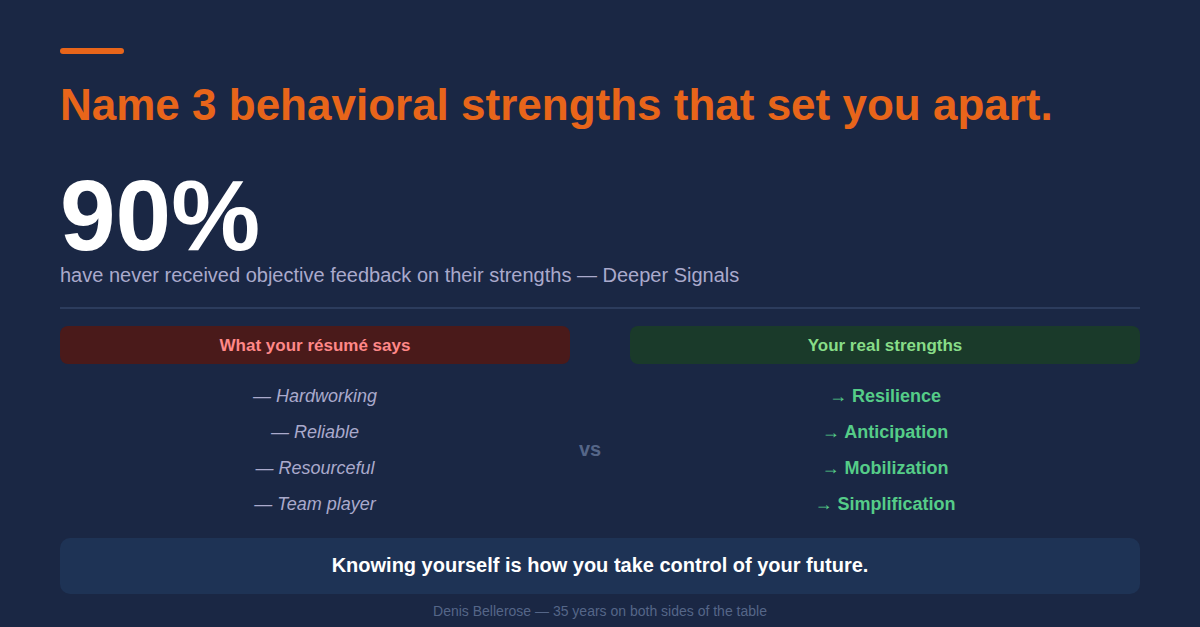
Hesitating? That's normal. A study by Deeper Signals shows that only 10 to 15% of professionals are truly aware of their strengths and the impact of their behaviors. 90% have never received objective feedback on the matter.
If you read my first article on job changes, you might recognize yourself in this sentence: "I, too, hesitated to ask questions in interviews." Several readers told me so, in comments and in private. In this second article, I want to push the reflection further and tackle a concrete question: what truly makes you unique in an employer's eyes — beyond the résumé?
If I had to do it all over again — my 10+ transitions over 35 years — here's exactly what I would have wanted to know about myself BEFORE looking.
The Question That Disarms 90% of Professionals
"Name three behavioral strengths that set you apart."
Ask a colleague, a friend, or even yourself in front of a mirror. You'll see: the answer comes slowly, hesitant, often generic. Hardworking. Reliable. Punctual. Team player. Words that say nothing because they describe an acceptable employee, not you specifically.
The problem isn't that you lack strengths. It's that no one ever helped you name them.
My Own Strengths — The Ones No Line of My Résumé Showed
For the first half of my career, I would have been incapable of answering that question. I knew what I did — my titles, my mandates, my deliverables. But I didn't know how to name how I did it, nor the precise value I brought.
When I finally named them, here's what came out:
- My resilience when facing impossible projects
- My anticipation of problems before they manifested
- My ability to mobilize a team around a clear vision and target
- My instinct to simplify what is complex
- My capacity to listen in a way that clarifies an issue, a problem, a solution
These are the strengths that earned me every promotion and every mandate — often without my knowing it. But no line of my résumé mentioned them. My résumé listed functions and results. Not the invisible mechanics that produced them.
That invisible mechanic is exactly what employers are looking for in interviews. And it's exactly what most candidates can't articulate.
The Problem from the Other Side of the Table
As a manager, I saw the same problem in reverse. In interviews, I would ask the classic question: "What sets you apart most?"
And I'd get generic answers. Hardworking. Reliable. Punctual. Resourceful. Team player.
Words not without importance — but ones that don't resonate for an employer, and that don't spark any real conversation. They slide off. The candidate ticks a box and moves to the next question. As an interviewer, I learned nothing about the person across from me.
From the candidate's side, it's even worse: they leave the interview with the impression of having "answered well," when in reality they said nothing that distinguishes them. They delivered a variation of what the 50 other candidates also said.
"Hardworking, Reliable, Resourceful": Why These Answers Fall Flat
These words aren't wrong. The problem is that they're not differentiating. They describe what's expected of any competent employee, not what makes you unique.
Imagine two candidates for a project manager role:
- Candidate A: "I'm hardworking, reliable, resourceful, and a good team player."
- Candidate B: "I have a particular ability to anticipate roadblocks before they become crises. When project X started going off the rails in 2023, I saw the cross-team coordination issue coming six weeks before everyone else. I proposed a restructuring of our governance committees, and we delivered on time."
Which one do you hire?
The two candidates may have identical résumés. Candidate B simply did work that Candidate A didn't: they identified the mechanic of what they do well, and they know how to tell it with concrete proof.
How Standout Candidates Build Their Answer: The Achievement as Evidence
Candidates who stood out in interviews, in my experience as a manager, all followed the same structure — often without knowing it. Not jargon, not a coaching technique. Simple logic:
- A precise behavioral strength ("I anticipate roadblocks")
- A concrete achievement where it manifested ("on project X, in 2023")
- The tangible result ("we delivered on time despite the crisis")
That's it. But it's radically different from "I'm resourceful."
Not "I'm a leader" — but "when project X went off the rails, I rallied the team and leadership in 48 hours by doing this, and here's what happened."
Not "I'm good at problem-solving" — but "facing a 30% budget cut mid-year, I identified three simplification levers that allowed us to keep 80% of the original deliverable."
The difference is enormous. You move from a generic adjective to a story only you could tell, because it's your story. That's what distinguishes. That's what initiates a conversation between equals with the employer.
The Other Question No One Teaches You to Ask
Once your strengths are identified, an even more rarely-asked question remains: what makes you happy at work?
Not "a good salary." Everyone wants a good salary. The real criteria are more precise:
- What kind of challenges actually stimulate you? Building from scratch? Optimizing the existing? Crisis resolution?
- What culture makes you perform? Hierarchical and structured, or flat and autonomous? Competitive or collaborative?
- What level of autonomy is necessary for you to give your best?
- What values are non-negotiable for you — the ones whose absence would make you miserable within six months?
According to Gallup's State of the Global Workplace 2025 report, barely more than one in five workers feels truly engaged at work. Not because good jobs don't exist — but because no one helps them identify what truly differentiates them, nor what makes them perform. The others accept positions that "look good on paper" and discover six months later that they're not in the right place.
What Changes When You Truly Know Who You Are
If I had known all this before each of my transitions, here's what would have changed.
In interviews, I wouldn't have hesitated to ask questions. I would have known exactly what to ask: about the culture, the management style, the actual level of autonomy offered. I would have read between the lines of the employer's answers, because I would have had my own clear criteria in mind.
I would have had the courage to turn down certain offers. Several times in my career, I accepted positions because they represented a promotion or a better salary, without asking myself whether the actual environment matched what makes me perform. Three out of ten times, it was a mistake.
I would have accepted the right offers faster, and more confidently. Because I would have recognized a good match by the second interview, instead of doubting for three weeks.
Knowing yourself and being able to explain it through achievements is how you take control of your future.
The good news is that it's now possible to do this introspection work in a structured and accessible way — without paying $300/h for an executive coach, or waiting for a formal career review at age 50. The tools exist. The method exists. What's missing is just a guide that walks you through it step by step.
What Now?
Before your next job change, take 20 minutes to identify your real strengths.
SoiWISE guides you through structured professional introspection — to transform "hardworking, reliable" into concrete narratives that truly set you apart, and to clarify what actually makes you happy at work. Choose, don't settle.
Read also: Changing Jobs 10–15 Times: Why You Must Prepare First — why your next job change deserves real preparation.
Denis Bellerose is the founder of SoiWISE.com and the co-author of Ingénierie de la performance des organisations (2021). With 35 years of experience on both sides of the table — as employee, manager, consultant, and entrepreneur — he now helps professionals navigate their key career moments, alongside two seasoned HR and recruitment specialists.