Changing Jobs 10–15 Times: Why You Must Prepare First
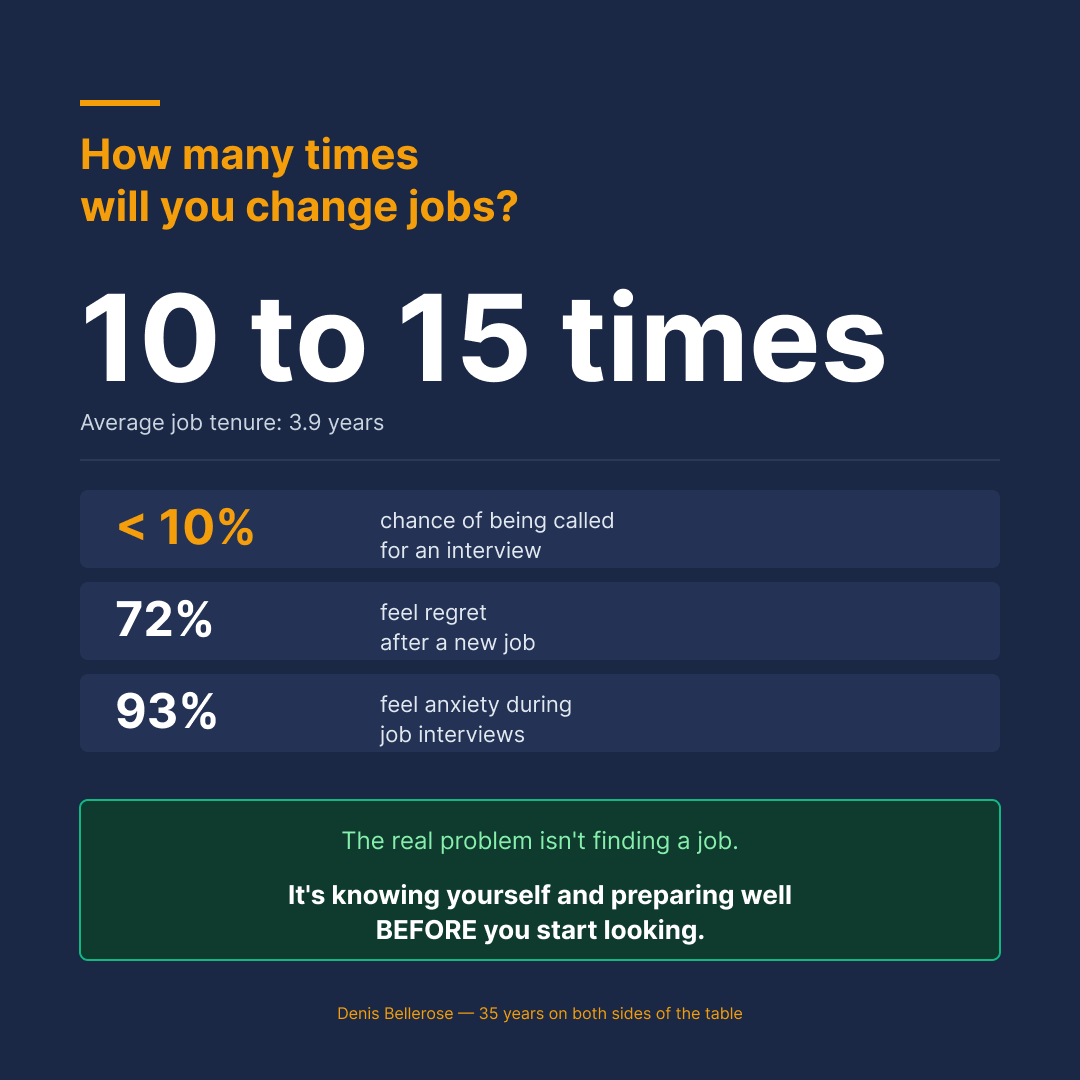
You'll change jobs 10 to 15 times in your life. 72% feel regret afterward. The real challenge isn't finding a job — it's knowing yourself before you start.
For some, it's a routine. Update the résumé, send out a few applications, and you're done. For most people, it's one of the most stressful — and least prepared — moments of their professional life.
The numbers are clear: a professional will change jobs between 10 and 15 times during their career, with an average tenure of 3.9 years. And yet, nine times out of ten, the same story repeats itself: people endure, then flee, then accept too quickly. And the cycle starts again.
Here's why your next job change deserves better — especially in 2026.
My journey: 10 changes in 35 years, on both sides of the table
Over 35 years of work, I changed jobs every 3.6 years on average. Regional director in a multinational, independent consultant for over a decade, expert advisor to the Government of Québec, entrepreneur — twice rather than once.
And for a good ten of those years, I sat on the other side of the table. As a manager, I was the one — alongside HR — running interviews, hiring, conducting annual reviews, and yes, handling some terminations.
I know both sides of the process. And I can tell you this: whether you're a candidate or an employer, the current system is rudimentary and frustrating.
For most of my career, the market let me get away with it. Demotivated and getting no response from my management, I'd update my résumé, do a few interviews, and move on. That luxury is disappearing.
Why 2026 changes everything: the end of the "luxury of mistakes"
The 2026 job market is no longer the one you knew in 2018, or even in 2022. The numbers tell the story.
JPMorgan announced at the end of 2025 that the first half of 2026 would deliver "uncomfortably slow" growth in the labor market, with U.S. unemployment expected to peak at 4.5% in early 2026. The bank pointed to a shrinking labor supply, an aging population, and an AI capital shift that's pulling investment toward equipment, software, and data centers — not toward job creation.
More telling still: the Challenger report cited by JPMorgan showed that roughly a quarter of announced job cuts in March 2026 listed AI as the reason — a sharp increase from prior years. And a Pew Research poll found that only 5% of U.S. workers expect AI to create more opportunities for them, while 64% expect fewer.
The SHRM describes the resulting environment as "low-hire, low-fire": companies hesitate to bring people in, hesitate to let them go, and the pool of accessible opportunities keeps shrinking. If you make the wrong move in 2026, the next opportunity may not be there in 6 months. It might be there in 18.
Your next job change may be the most important of your career.
The real cost of a bad change
Here's where it hurts. Three numbers to commit to memory before clicking "Apply":
- 72% of workers feel regret after a new job (The Muse, picked up by CNBC).
- 30% leave within the first 90 days (BambooHR).
- Less than 10% of applicants are called for an interview for a given position — unless you open the door through a referral or a highly targeted application.
I'll be honest. Half of my own changes, the grass was no greener. I'd leave demotivated and hesitate to ask too many questions in the interview, afraid of losing the opportunity. But how do you turn down an offer when you're already miserable in your current job?
The trap is well-known: you flee, you rush, you accept. And three months later, you discover that the culture, the manager, the mission, or the team dynamic doesn't fit. The cycle starts again — except in 2026, it starts again in a tighter market, with one more scar on the résumé.
The classic trap: fleeing instead of choosing
There's a fundamental difference between fleeing a job and choosing the next one.
Fleeing is a response to pain. It's saying "anything but this." It's applying to 30 postings in two weeks because you can't take your manager, your team, or your workload anymore. It's accepting the first reasonable offer because the prospect of staying one more month is unbearable.
Choosing is something else. Choosing assumes you know what you're looking for, not just what you're leaving behind. Choosing assumes you've taken the time — before you even update your résumé — to honestly answer three questions most people never ask themselves:
- What made me perform well in the past? Not just the skills, but the conditions: type of manager, team size, level of autonomy, pace, sector.
- What made me suffer? And is what I'm experiencing today an acute version of something that comes back in every job?
- What am I actually looking for now? Not in 5 years. Now. Stability? Learning? Compensation? Purpose? Work-life balance?
If you can't answer those three questions in five minutes, you're not ready to apply. You're ready to flee.
What people who succeed in their transition do differently
Those who succeed in their job change do things differently. Not because they're luckier, more talented, or better connected. Because they did work the others didn't.
They can name their behavioral strengths. Not their technical skills — those are on the résumé. Their strengths: how they solve problems, how they interact with a team, how they perform under pressure. When asked "Name three strengths that set you apart," they don't recite a script. They give an example, a situation, a result.
They know the environment in which they perform. They know they need a manager who gives them latitude — or, on the contrary, a clear framework. They know they perform in a team or in autonomy. They know they need variety or depth. That self-knowledge changes how they read a posting — and how they listen during an interview.
In interviews, they ask real questions. Not "What are the benefits?" at the end. But "Can you describe the last time a difficult decision was made on this team — and how it was made?" Or "What would make you, 18 months from now, regret hiring me?" The interview becomes a conversation between equals. And it's the best interviews that lead to the best matches.
The real problem: nobody ever taught you to know yourself
Here's the statistic that pushed me to found SoiWISE: 93% of candidates feel anxiety in job interviews (JDP). Not from a lack of skills. From a lack of clarity about themselves.
We're taught how to write a résumé. We're taught how to write a cover letter. We get a few tips on posture, eye contact, the "30-second pitch." But nobody teaches us how to know ourselves before we go looking for a job.
Yet professional introspection isn't a luxury reserved for those with time on their hands. It's the foundation that turns a job change you endure into a transition you choose. It's what separates the 30% who quit within 90 days from the 70% who stay — and within that 70%, the third who thrive from the third who merely survive.
The real problem isn't finding a job. It's knowing yourself BEFORE you start looking.
What now?
Before your next job change, take 20 minutes to know yourself.
SoiWISE guides you through structured professional introspection — to identify your real strengths, the environment where you perform, and what you're truly looking for in your next step. Whether you're reflecting, transitioning, or simply taking stock, the path is the same: choose, don't settle.
Denis Bellerose is the founder of SoiWISE.com and the co-author of Ingénierie de la performance des organisations (2021). With 35 years of experience on both sides of the table — as employee, manager, consultant, and entrepreneur — he now helps professionals navigate their key career moments, alongside two seasoned HR and recruitment specialists.