Changing careers — but to what?
You want a different career, but you don't know which one. That isn't a lack of ambition — it's a lack of clarity. And fifteen years of achievements already hold the answer.
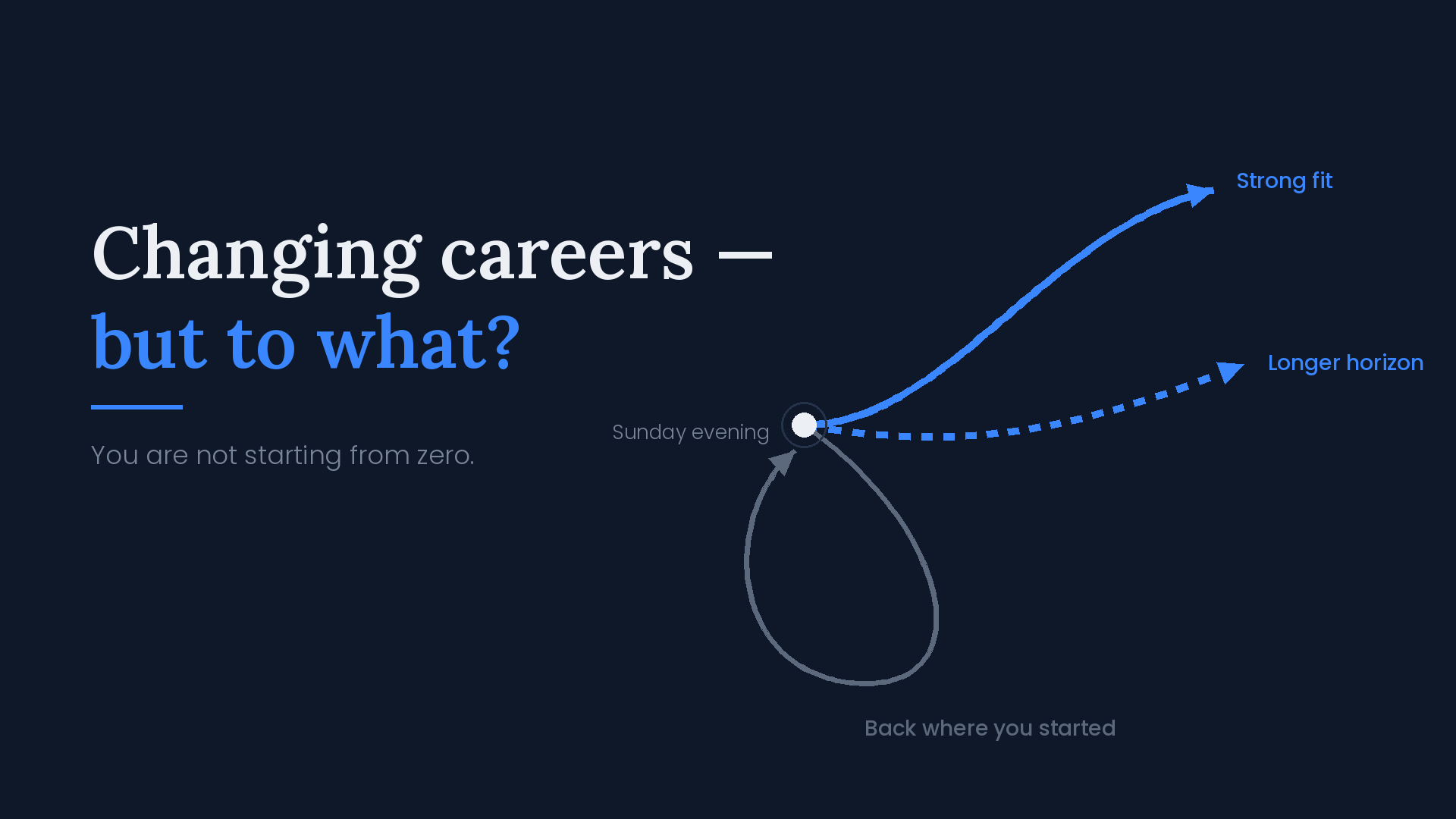
There is a conversation many professionals between 45 and 55 have with themselves, usually on Sunday evening. It opens with "I don't want to do this anymore" and closes, a few minutes later, with "but I don't know what else I'd do." Then the week starts again.
The conversation keeps coming back because it is badly framed. It treats a career change as a leap into the void — leaving what you know for something you don't. Seen that way, staying put is the rational answer.
But it isn't a leap into the void. It's a transfer of assets.
The real obstacle isn't ambition
When someone says "I want to change careers but I don't know what to do," the usual response is personality tests, interest inventories, lists of in-demand jobs. These tools rest on a premise: that the person doesn't know themselves well enough.
That is rarely the problem. After fifteen or twenty years of working life, you know yourself. You know what wears you down, what carries you, what people come to you for when something is stuck. What's missing is not self-knowledge — it is a reading of what you have already done, organized so that the exits become visible.
In other words: you are not short on ambition. You are short on clarity. And clarity is not found in a generic questionnaire. It is found in your own achievements, reread with the right question.
What your achievements know that your job title doesn't
Your job title describes your function. Your achievements describe your value — and the two rarely tell the same story.
Take three achievements you are proud of, from different points in your career. Describe each one honestly: the context, your exact role, what pushed back, the result and how it was established. Then look for what they have in common.
What surfaces is almost never a set of technical skills. It is a set of through-lines: ways of working you have repeated across different contexts, without anyone asking you to. Some people bring structure to what was disorganized. Others make the people around them grow. Others are, every time, the person who gets called when a file is stuck between two teams.
These through-lines are not attached to your industry, your employer, or your title. They travel. And that is where the answer to "what else" lives: not in a job that resembles you, but in a job that needs your through-lines.
An example: Catherine or Jacques, 47
Here is what this reading looks like when it is carried all the way through. The example is illustrative — the career is fictional, the method is not.
Fifteen years in the same industry, a solid reputation, recognized results — and for the past year, a growing conviction that the next chapter has to be different. Different how? That is exactly the question that blocks.
What the career reveals. The achievements of the past fifteen years tell a broader story than the job title. Three through-lines emerge: bringing structure to what was disorganized (a service-process redesign that cut turnaround times by 40%), training and growing others (12 training modules that became the internal reference), and being the person who gets called when a file is stuck between two teams. The value is not attached to the industry — it travels.
Three paths, in order of fit.
Operations improvement consulting — strong fit. The process redesign and the habit of navigating between teams are exactly what this role demands day to day. It is the pivot with the best effort-to-result ratio: you change context without changing your strengths. Gap to close: learning to sell your expertise, not just to exercise it.
Training and skills development — strong fit, longer horizon. The training modules were not one task among many — they are the thread of the career where the energy is most visible. This pivot calls for a more gradual transition (certification, first assignments on the side), but it aligns with what nourishes you, not only with what you know how to do.
Transformation project management — moderate fit. The strengths apply, but this role would lead back to what you are trying to leave: permanent urgency and endless trade-offs. Worth considering only if the first two paths close.
The first step — the next 30 days. Don't resign. Don't enrol in a degree. Test the first path at small scale: find two people in your network who do this work and ask them for thirty minutes — not for a job, to understand their actual day. A decision this size should rest on facts, not on an image.
Why the third path matters as much as the first
Look at the third path in the example. It fits. The strengths apply. And yet it is ranked last — because it would reproduce what the person is trying to leave.
This is the most common mistake in changing careers: pivoting toward what you can do without checking whether it is what sustains you. You change employer, industry, sometimes title, and eighteen months later you find the very same Sunday evening.
That is why reading your achievements is not enough on its own. It has to be crossed with your aspirations — your values, your motivations, what you will never accept again. Achievements say where you can go. Aspirations say where you want to go. The chosen path sits at the intersection.
What you can do right now
You don't need a tool to start. Take an hour, three achievements, and the five questions: context, exact role, what pushed back, result and how it was established, in hindsight. Write. Then look for the threads.
If you want to go all the way — the through-lines named, the paths ranked, the 30-day first step — that is exactly what the Shift your trajectory key moment does on SoiWISE. It starts from your real achievements, not a generic questionnaire, and it tells you what's missing when a section is too thin to conclude.
Your first key moment is free, no credit card, until October 31, 2026. Zero cookies, zero trackers: your reflections belong to you.
Career intelligence, for every key moment.
Read also:
- 8 Key Career Moments: Arrive Prepared at Each One — the complete mapping of the 8 moments where your career plays out
- Changing Jobs 10–15 Times: Why You Must Prepare First — why your next job change deserves real preparation
Denis Bellerose is the founder of SoiWISE.com and the co-author of Ingénierie de la performance des organisations (2021). With 35 years of experience on both sides of the table — as employee, manager, consultant, and entrepreneur — he now helps professionals navigate their key career moments, alongside two seasoned HR and recruitment specialists.