Introspection Before Opportunity: Decide Without Regret
A Tuesday morning. A promotion lands. Five days to decide. Why the best-prepared aren't the most qualified — they're the ones who introspected first.
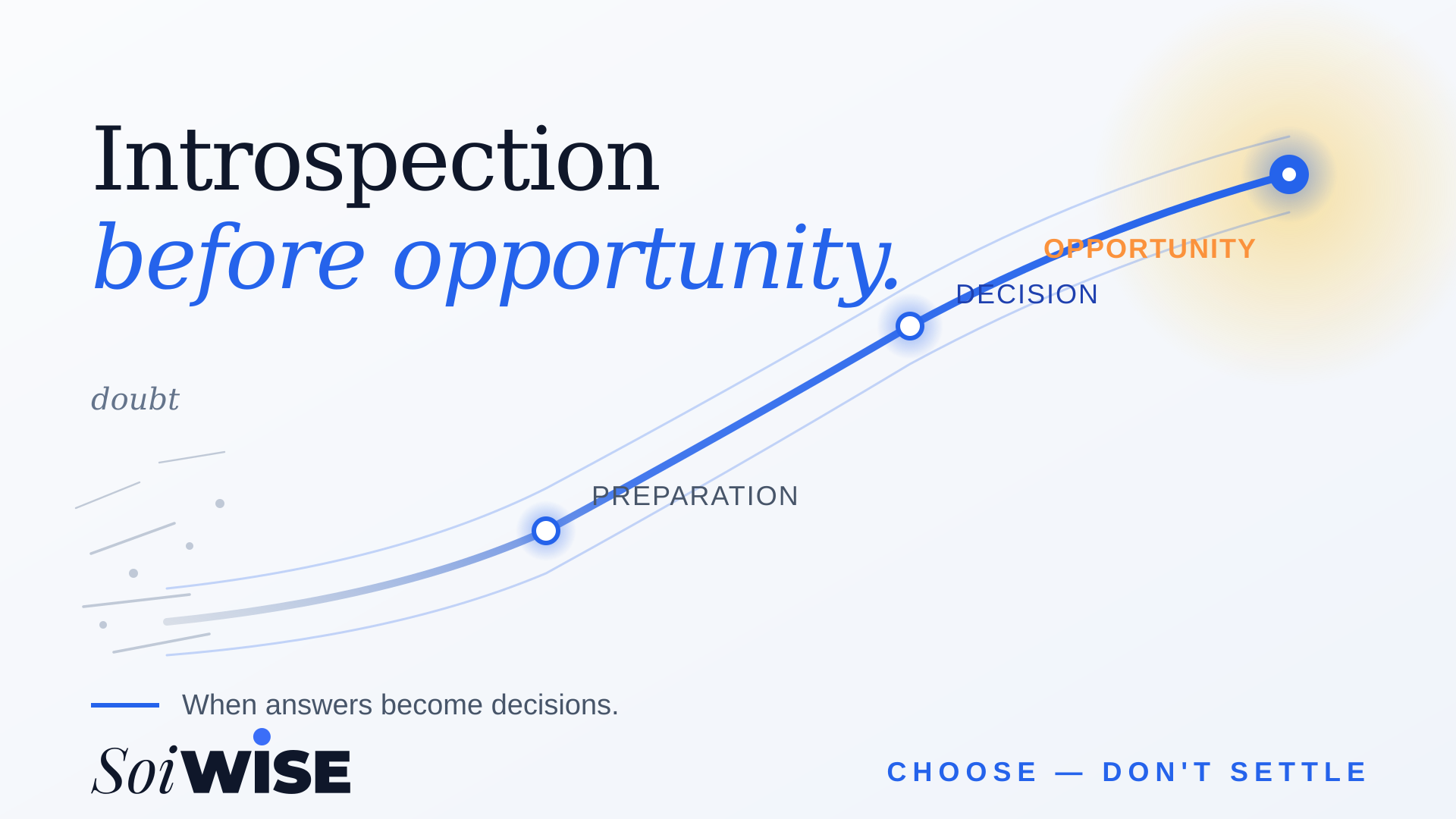
A new combined position with a promotion has just been posted internally. They tell you: "Go for it. It's made for you. You've got nothing to lose."
And right there, in your head, the machinery starts.
Should I go for it? Should I not? Where do I begin? What questions do I ask? What will they ask me? Am I really cut out for this role? Is this the right time? My family? My current boss?
You have 5 days to apply.
You already know what's going to happen. You'll think about it at night, lose sleep for 2-3 nights, talk it over with your spouse, maybe a friend. You'll look for signs. And in the end, lacking clear bearings, you'll probably let it pass.
Not for lack of desire. For lack of answers. For lack of conviction.
Doubt, when it settles in without counterweight, almost always wins.
What 30 Years Have Taught Me
In 30 years, I've watched this scenario replay dozens of times. From both sides of the table. As a regional director offering promotions, as a colleague supporting transitions, as an entrepreneur recruiting.
And every time, the same conclusion:
Those who decide well — whether they accept or refuse — are not necessarily the most qualified. They're the most prepared.
Not prepared for that particular opportunity. Just prepared. Prepared beforehand.
They can name their strengths without hesitation. They know the environments that make them perform and the ones that drain them. They have a clear read on what they want to negotiate, what they won't budge on, what's negotiable.
When the opportunity arrives, they don't improvise an introspection in 48 hours — they consult work that's already done.
And that changes everything.
Why 48 Hours Is Never Enough
The "I'll think about it this week" trap is known to anyone who's tried it. The problem isn't time. The problem is that serious introspection cannot happen under pressure, with a clock ticking and an opportunity weighing on you.
When you have 5 days to decide, your brain isn't doing introspection. It's doing rationalization: it's looking for arguments to confirm a decision it's already made emotionally (often: let it pass, because that feels like the least risky option in the short term).
Real introspection requires downtime, with no immediate stake. It requires being able to write, reread, doubt, return, adjust. It takes weeks, sometimes months. Not sleepless nights under stress.
That's why those who decide well have done this work beforehand. When the opportunity arrives, they don't create the material — they consult it.
The 8 Key Moments Don't Wait Until You're Ready
Because key career moments don't wait until you're ready:
- An annual review that takes an unexpected turn
- A conversation with your manager about your future
- A promotion offered on a Tuesday morning
- A salary negotiation shaping up to be tough
- A recruiter who finds you on LinkedIn
- A reorganization that reshuffles the cards
- A career pivot you sense rising without daring to name it
- A job interview for which you don't have time to prepare properly
Eight moments. Millions of professionals navigate them every year. Most of them, unprepared. That's exactly the mapping I shared last week and that SoiWISE now covers entirely.
The Highest-ROI Investment of Your Career
Professional introspection isn't a coach's luxury or a vaguely spiritual exercise. It's the highest-ROI investment you can make in your future.
How much does a bad career decision cost? Not just in money — in time lost, in energy spent compensating for a poor fit, in mental health eroded by 18 months in the wrong role. How much does a "I should have" cost when it comes back to haunt you regularly at 3 AM?
Conversely: how much is a clear decision worth, made with lucidity, that you don't have to revisit for 5 years?
The gap between the two often plays out in a few hours of introspective work done at the right time — that is, before the opportunity arrives.
What Actually Changes, the Day It Arrives
Because the day the opportunity presents itself — and it will present itself — the answers are already there. Doubt gives way to clarity. And the people across from you immediately perceive the depth of your reflection.
This has become, in my own experience as a recruiter, the number-one selection criterion between two candidates with equivalent technical skills. Not the most brilliant résumé. The candidate clearest about themselves.
Concretely, here's what happens when you arrive prepared at one of these moments:
In an internal or external interview, you don't recite a script. You tell your professional signature with precise examples (I covered this in detail in my article on the 3 behavioral strengths). You ask the real questions instead of avoiding them out of fear of looking bad.
In a salary negotiation, you know what you're worth and what you won't concede. You arrive with your personal range, not just market ranges.
Facing a proposed promotion, you evaluate within 24 hours whether the promised environment matches what makes you perform — instead of accepting out of flattery or refusing out of fear. And if you refuse, you do it with clear arguments that preserve the relationship and open the next opportunity.
Facing a reorganization, you immediately understand where you want to position yourself in the new structure, and you negotiate it with confidence.
And at Worst?
At worst, you and your potential employer will conclude together that this isn't the right opportunity at this moment.
That's not a failure. It's a clear decision, made with eyes open, without the scar of "I should have given it a shot."
Introspection done well never loses. It reveals.
It reveals that this promotion would actually move you away from what makes you perform. Or on the contrary, that it's exactly what you were waiting for without daring to articulate it. It reveals that this LinkedIn recruiter is offering you a role aligned with your signature, or that they're off the mark. It reveals that your current discomfort comes from your manager, not your profession — or the opposite.
In every case: you decide with a compass, not with an emotional barometer.
What We're Building with SoiWISE
That's exactly what we're building with SoiWISE: professional introspection for every key moment of your career.
Seven pillars, two phases: first, know yourself (free, no time limit), then, decide. Not the other way around.
When your next Tuesday morning arrives — and it will arrive — you won't have to improvise reflection in 48 hours. You'll have to consult work already done.
Launching Q2 2026. Waitlist open at soiwise.com.
Choose. Don't be chosen.
Read also:
- 8 Key Career Moments: Arrive Prepared at Each One — the complete mapping of the 8 moments where your career plays out
- 3 Behavioral Strengths That Set You Apart — the question that disarms 90% of professionals in interviews
Denis Bellerose is the founder of SoiWISE.com and the co-author of Ingénierie de la performance des organisations (2021). With 35 years of experience on both sides of the table — as employee, manager, consultant, and entrepreneur — he now helps professionals navigate their key career moments, alongside two seasoned HR and recruitment specialists.